Showing posts with label wool. Show all posts

Tuesday, December 30, 2008

A Handspun Gift

I've come a long way from my earliest tentative days of fashioning wiry, scratchy, overtwisted yarn (albeit with a great sense of excitement!) My spinning has come along to the point that I feel comfortable enough to give something made of my hand-spun yarn, at least to an indulgent and tolerant family member.

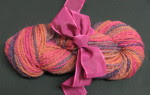
At the Shenandoah Valley Fiber Festival this fall, among other treasures, I picked up this little ball of hand-dyed Romney roving from Catoctin Creek Farm, near Frederick, Maryland. (I have to think kindly of people who care enough about a humble ball of roving to tie it up with a satin ribbon.) I hadn't spun wool from Romney sheep before, and the colors seemed bright and kid-friendly. I thought it would be fun and might make a cute scarf.

Spinning the Romney wool was a real pleasure. It's a long-wool breed, with long, luscious fibers that drafted out so smoothly that they made me feel like a more skillful spinner than I really am. It felt cottony and flossy. The preparation was immaculate, a very welcome change from some of the fiber I'd been working with over the summer.

For spinners, who may care about such things, I split the rope of hand-dyed roving lengthwise and spun the two halves onto separate bobbins. The plan was for the color changes to occur in more or less the same place so that the colors would stay mostly pure when the strands from the two bobbins were plied together.

When I began plying, though, I found that either my splitting or my spinning was uneven enough that the results were unpredictable. The colors blended and softened and became surprisingly complex. It was prettier and paler than I'd imagined. The colors began to remind me of my grandma, who's always looked pretty in pastels. I started thinking that just maybe I could make something for her.

This was no small matter. I'd only knitted from my hand-spun twice before. Of my earlier efforts, another relative had said, "hmmm, it's kind of scratchy." That hadn't exactly encouraged me to think of it as gift-worthy. (And I have to admit that, while I do love the two hand-spun sweaters I've made thus far, I wouldn't be anxious to wear them against bare skin.)

I was reading something at the time that gave me a notion that fulling the yarn might make it a bit softer and woollier, so I decided to give that a try. When all the yarn was spun, after consulting my spinning books, I took my latest fiber processing tool in hand. (Yes, a plunger.) Ignoring the yarn's cries of protest, I shocked it cruelly in hot water and cold, and commenced to beating it senseless.

I didn't like doing it, but it was for its own good. I also learned a couple of lessons myself. One is that enthusiastically agitating yarn in a large sink of water is a very splashy operation. Less water next time. Or a raincoat.

Despite a certain skepticism I still harbored about the wisdom of all this, the yarn survived and even bloomed. The strands lightened and loosened, but bound together more as a whole, and developed a fuzzy halo. I think this may have been an experiment worth repeating.

I worked out a design for a scarf and got to knitting, thinking of my grandma all the while.

It was entrancing, watching the colors shift and merge as the scarf grew from the needles. And nothing really repeated. The color patterns were unique the whole way through. It was a lovely experience, from one end to the other.

I'm still worried about whether it's soft enough. For myself, I wouldn't mind a slight cold-weather scratchiness at all. But this is for my grandma. I think I spun it as softly as Romney can be spun, with low twist and plenty of air. But it is simply a coarser wool than the aristocrats of the woolly world, like merino. So I wish I could give it that buttery feeling, but it has its own nature. If it's not perfectly comfortable against her skin, maybe she can wear it outside a coat collar. Or not wear it at all, and just show it to her friends, and say "my granddaughter made this."

So I wrapped it up tenderly and shipped it off for Christmas, hoping that it will be nice enough. At least she will know that I wanted to make her something that I spun myself.

I hope she likes it.

Saturday, July 5, 2008

Tour de France/Tour de Fleece

For years, world's-most-patient-husband and I have spent much of July glued to the TV watching the drama of the stupendous 1200-mile Tour de France bicycle race unfold. I've also spent much of that time clicking away on my knitting. Of course, in the last year or two, I've also developed a certain attachment to spinning. You might have noticed. :)

So I was tickled when I happened upon Star Athena's Tour de Fleece a few weeks ago. It's spinning in the theme of the Tour de France, with personal challenges and like-minded company. I like spinning; I like watching the race; perfect! I joined her Tour de Fleece group in Ravelry right away. It's great fun to see what others are tackling as their Tour de Fleece spinning goals, from spinning for speed, to lace-weight, to tricky fibers, to art yarns in the spirit of the wild creations of Pluckyfluff.

There's another Tour de Fleece on the web as well, incidentally, Le Tour de Fleece. It appears they're both now in their third year. But Star Athena's version looks like the more easygoing of the two, with no urgent race to complete a goal before the bicyclers reach Paris, but just a pledge to spin every day and lots of opportunities to make it fun. That's clearly the one for me!

I laid my plans and did just a little advance preparation. Call it training. I decided to spin the other three colors of my foolish lump-bedeviled roving bargain. That will be the demanding terrain I have to get over. Having blended and spun the first three colors into the rustic Stormwatch yarn, which turned out better than it had any right to, I decided to spin the remaining three colors individually, and make a three-ply yarn of them.

And don't those pretty colors look innocent just sitting there? They give no clue of the lumpy soul that lurks within. There will be no picking out all those lumps. We will just have to transcend them like a hill stage on the Tour. Alpe de Nepp, you might call it.

I went ahead and tried spinning a bit of each color. I spun it more thinly than the singles for the Stormwatch yarn, partly because three plies will make a thicker yarn than two, and partly just to see if I could, with this bumpy stuff. Then I tried out plying the three strands together, a first-time experience. It didn't seem to go too badly. This is the little sample skein I would up with. Really, I quite like it.

With the three finer plies wrapped together, my sample seems to be something like a heavy worsted weight. I knit it, with US size 9 needles, if I remember aright, and wound up with this nicely tweedy swatch. Something about the mixture of colors and the visual texture makes me think of a Chanel-style jacket, so that may be what it's destined to be. French-inspired, so appropriate!

The challenges for me will be several. Spinning finer plies around the lumps. Spinning intentionally and consistently to the same gauge as my sample. Spinning every day (travel permitting). Getting the twist right and three-plying a balanced yarn.

So my training was done, and I just had to wait, staying away from spinning and champing at the bit with growing impatience, for the real Tour to start. When the time finally came this morning, Rastro and I were suited up and raring to go.

And we're off!

Tuesday, May 27, 2008

Accentuate the Positive

Eliminate the negative. After a wretched week with that stomach bug, I'm already back to feeling positively chirpy!

So let me tell you what I've been doing with the pennywise roving. This is the generic bargain roving that I bought on a whim, without looking too closely, only to find when I got it home that it's filled with lumps. But beauty is only skin-deep, as they say. I went looking for its inner beauty.

I bought six colors, with blending in mind. Three of them I put aside, thinking they looked particularly nice together. That left me, hoping for the best, with these three. I have a half-pound of each, about the right amount, in all, for a sweater. The colors looked, if not exciting, at least possibly compatible. And, to be honest, I really didn't feel like I had a lot to lose.

So off I went with it to the Frumious Bandersnatch, my drum carder, to see what we could make of it. I took a hunk of each color and pulled the compressed sausages apart, opening them up into filmy layers. They sighed with relief to get some air. Having a heathery effect in mind, I stacked the layers on the intake tray.

After it was all cranked through onto the drum, the wool looked like this. It was better than I expected. Rather a nice streaky effect, I thought. And, though muted in color, not a bit dull.

This, incidentally, is what the Frumious Bandersnatch lives for! The main reason I wanted a drum carder in the first place was to be able to play with blending colors and fibers. The yearning for raw fleece came later, once the idea of a drum carder had sunk in for a while and made itself right at home.

Anyway, rather than running the wool through again to mix the colors more thoroughly, I decided to stop right there. I peeled the batt off the drum, rolled it up, and stretched it out into a pleasantly streaky ball of roving. Then I made another, and another. I rather grew to like it.

Oh, I haven't lost sight of the fact that it's full of mess. You can see that just by looking. It's just that I've gotten over the initial shock. I can look past the homely exterior and see the character within. I can contemplate long sessions of lumpy-oatmeal spinning with equanimity and envision a comfortable, nubby sweater as the eventual result.

Driving home one evening a week or two back, I noticed a really dramatic-looking sky. It was freshening for a storm. Deep, thunderous blues were slashed across with clouds in frowning, dirty beige, and ethereal silver-gray. It was utterly beautiful. And in fact, it was almost exactly the colors now streaking through the blended pennywise roving. So I now have a name for the roving, the yarn, and whatever sweater is made from it: Stormwatch.

See? Inner beauty.

Monday, May 12, 2008

Nothing but Nepps

Sometimes an impulse should be resisted.

On impulse, last week at the Maryland Sheep and Wool Festival, because it seemed like a bargain, I bought half a dozen bags of generic wool roving in pretty colors, half a pound each. At that point, I was practically shopped out and ready to leave, and that's probably exactly what I should have done.

I haven't mentioned the vendor's name in previous posts and I shan't now, because this roving is a mess. It's the first time I've experienced wool so badly prepared. It's honestly very much like what I was removing from the drum carder to throw away when processing my own little fleece. It seems to be, literally, almost nothing but nepps. For non-spinners, nepps are those little balls of lumpy fiber you see in the picture instead of a nice smooth river of wool.

I have to believe that their product is usually better than this. Perhaps they let the children run the woollen mill for a day?

I took samples of the gray, light brown, and blueberry colors and blended them using my drum carder. I wanted to see how they would look together, and whether some of the messy stuff might card out. That didn't happen; to get rid of the messy parts, I'd have had to throw away the whole lot. In fact, I thought seriously about cutting my losses and doing just that. I wished I knew someone who needed a quantity of wool to stuff a mattress with.

Failing that, I thought, let's just try it out and see what it's like. After all, isn't silk noil made up of all the little bumps like this that don't make it into the smooth silk fiber preparations? Wool noil, that's what it is! I took the blended roving to my spinning wheel Rastro to see what the two of us could make of it. I started spinning and found that, try as I might, it was going to come out as lumpy, bumpy, thick and thin yarn. Maybe I could go with it and knit it into some kind of very slouchy, casual sweater. In any case, there was no way to spin anything else with this roving. Slubs automatically formed around all the little fiber pills. I actually wondered if there was enough good sound wool in the mix to serve as connective tissue between the bumps.

Nevertheless, I spun a couple of single strands and plyed them together. The result was better than I expected. The spinning itself is painful, and I'm not convinced the yarn is strong, but it's holding together for now and doesn't look half bad. It just looks like a very rustic yarn with lots of texture and character. If I can stand spinning my way through a pound and a half of this involuntary bumpiness, maybe I'll have the makings of an attractive simple sweater.

I'm so glad I didn't encounter wool like this any earlier, before I got some decent spinning experience under my belt. I'd have thought it was coming out that way because I wasn't doing it right. I'd have tried and tried and probably ended up having a good cry out of sheer frustration.

Now that I more or less know what I'm doing, I can handle it, and maybe even make a silk purse out of a sow's ear. We'll see.

And then there will just be the other pound and a half of this stuff to get through!

Sunday, March 16, 2008

Oh Frabjous Day!

"Calloo, Callay!" she chortled in her joy.

Snicker-snack. We've made short work of my little Jacob fleece, the Frumious Bandersnatch and I. Here it is, my new Strauch Petite drum-carder, with its big teeth that clack. It was a thrilling Christmas present from world's-most- patient-husband, which I'd been itching to put through its paces. (But it wasn't the only thrilling fiber-related Christmas present, more on which another day!)

We began once the scoured fleece was clean and dry.


I decided to sort the wool to enjoy the separate colors rather than let them blend into a single mid-range tone.


I got to work, gingerly at first, loosening up the locks of wool with my fingers, picking out bits of straw and weeds as best I could, and laying the locks on the intake tray to be picked up by the toothy rotating drums and carded into batts of fiber. I learned as I went. Peeling the rectangle of carded wool off the drum, I would primp it and put it through again until it seemed reasonably smooth and well blended. When the first few batts were done, and drawn out and wound up into balls of roving ready for spinning, I was ready to burst with excitement.

As I got a little more practice, I noticed the lumps and little matted ends of the locks were taking several runs to untangle, and quite a bit of loose short fiber was collecting on the surface. Some locks had an awful lot of dried vegetable matter that was hard to pick out. Naively, I hoped that what I couldn't get out with my fingers would fall out on its own as the drum's teeth combed through it. Some did fall out, but more actually got broken up and distributed efficiently through the batt as I cranked.

It was time for some research on-line. I found that experienced carders recommend teasing as the best way to get the dry grassy bits out. Teasing, as they meant it, was more than just opening the locks of wool by hand as I had been doing. I needed a secret weapon.

This. A dog brush, a relic of my dearly loved fellows who have been gone for a while, though they lived to a ripe old age. I don't think they would mind. They'd have been very curious about all this wool and the creature it came from, and would have given it all a good sniffing over. Oh, I do miss them.

But the dog brush worked wonders. In a process called flick carding, it took out all the tangles and mats, sorted out the too-short fibers, and swept out the vegetable matter. The locks were so beautifully brushed and fanned out, once I'd been after them with the dog brush, that I half wondered at the necessity to run them through the drum-carder at all. But of course the drum-carder blends the colors beautifully, which vary significantly even within the separated colors, from one little lock to another, and from base to sun-bleached tip. And the rovings that result from drum-carding are the form I want for spinning, rather than individual locks, lovely as they are.

So, my later balls of roving were much slower to produce, but cleaner and more finely prepared than the earlier ones. Once I had worked out what it really took to prepare each bit for the carder, the pile of raw wool seemed to loom taller than ever. But I chipped away at it day by day, and now... victory!

I did lose quite a bit of weight in the processing (or rather, I didn't, but the fleece did). I started with 1.6 pounds and ended up with just over 1/2 pound. Some of this was the lanolin that washed out, and the weedy bits that I labored so hard to remove. Some of it was little tangles from the sheep just going about the business of being a sheep, getting rained on, drying in the sun, maybe getting stuck in a thicket, or scratching his itchy back up against a tree or fence-post. But there also seemed to be a surprising number of those unusable short clumps of fibers called second cuts, resulting from a certain, shall we say, insouciance in the shearing. Novice that I am, though, I'm sure a lot of the loss was due to inexperience, and I'll do better next time!

But now I have 1/2 pound of wool in three beautiful colors from one little sheep, lovingly prepared for spinning by yours truly. I'm so proud of it!

Tuesday, March 4, 2008

Five Things I Learned from a Fleece

Last fall at the Fall Fiber Festival in Montpelier, Virginia, I bought my first raw fleece. For a new spinner, it had begun to seem irresistible to take some wool essentially just as it falls from the sheep's back during shearing, and take it all the way through cleaning, and carding, and spinning. I could knit something I had carried from beginning to finished product.

Looking through the bags of wool in the fleece sale, I had no particular idea what to look for. Each different type looked like a wonderful adventure. The one I chose was from a Jacob sheep, from a local Virginia shepherd. These sheep are immensely appealing little fellows, both because they have parti-colored black-and-white coats, like a spotted dog, and because some of the rams are graced with rather strange-looking double horns.

Aside from admiring the breed itself, I was attracted to the chance to work with wool in more than one color and to the small quantity in this particular bag. It's only 1.6 pounds, which certainly isn't a whole fleece. But it was perfectly adequate to my purpose of just getting my feet wet at working with raw fiber. And isn't it beautiful?

Jacob fleece can be handled different ways for different color effects, blended thoroughly to make a heathery gray, or made into a sort of spotty ragg wool effect with different colors plied together, or the colors entirely separated to make different solid-colored yarns.

A week or two ago, I decided to jump in and have a go at the first step in the process: scouring the fleece, which means giving it a thorough washing to remove the lanolin and dirt. I had read about it in various spinning books and on-line. Once again, all I can say is all that book learning doesn't hold a candle to the experience of working with the real thing. There is nothing like trying it for yourself.

That little Jacob fleece has taught me quite a lot.

1. People who process wool for spinning really earn their pay. This is hard, time-consuming work. It's not particularly expensive to buy prepared rovings. To do this oneself, one needs to have a conscious reason. For this first try, learning what it's like was reason enough for me. After that, it might be for the satisfaction and self-sufficiency of creating things from the sheep forward. It might be to know what animal one's sweater has come from. It might be to be able to choose the perfect type of fleece for a particular purpose. It might be to have the control to prepare the wool in a specific way for the desired spinning result. But there ought to be a reason.

2. The life of a happy sheep is a life of plenty of dirt. Twigs. Weeds. Burrs. Ladybugs. Even, I fear, the occasional dingleberry (though in fairness, it may have been a food pellet). Playing with a fleece is a dirty business. Just trying to separate big wads of it for washing resulted in a lot of fallen debris. That may be a job best done in warm weather, outdoors.

3. There are a couple of things that make it easier to get it clean. It takes soaking in lots of hot soapy water to dissolve the lanolin and get the dirt out. But not necessarily the hotter the better. If the water is so hot you can't even handle the wool to squeeze out the water between soakings, then some very dirty water stays right in the wool, wash after wash. Mesh laundry bags make excellent containers to keep the wool organized and allow the water to run through. Zippered pillow-covers do not. They're too watertight, and the filthy water won't run out. Wash after wash. After a couple of rounds with a motley assemblage of mesh bags and pillow covers, I went to the store for more mesh bags. It was worth it. I think in the end, I washed the wool six or seven times in hot, hot soapy water, and another three or four times in clear rinse-water.

4. It's a smelly job. I'd seen people refer to raw fleece as smelly, and I didn't understand what the fuss was about. I could bury my nose in my lovely bag of unwashed fleece, and it had a pleasant mild animal smell, nothing at all to complain of. But when it's hot from the soaking water, ahh, that's a different story. It's a bit aromatic and gamy. Thankfully, once the wool is clean and dry, it smells sweet again.

5. I really don't know much about fleece. Are those stains, or just natural coloration? What makes a good fleece? Are those areas matted, or are those tight bundles just the normal structure? Has the fleece been skirted (messy wool removed from the edges)? I don't know what that looks like. I learned to recognize second cuts (too-short tufts of wool caused by the shearer's clippers running over the same spot a second time); how many are normal? How much can I handle the wet fleece without felting it?

But now I know a little more than I did before. I'll learn a little more yet with each time I try it. And it feels immensely satisfying to see the nice clean locks of wool spread out to dry, and to know that I can do this, and that I'll be making something with one little sheep's coat that I cleaned and prepared myself.

There's a lot of happiness in that. Reason enough.