Showing posts with label handspun. Show all posts

Sunday, January 30, 2011

Land of the Giants

Part of me feels I oughtn't to be allowed to wear a new knitted project until it's been blogged. My bubbly-sister-in-law once told me she had a rule that she couldn't use a gift until she'd written the thank-you note. Maybe that's where it comes from.

In any case, it's cold weather, and I have a warm cowl I need to tell you about, so I can wear it!

It all started back in the fall, at the Shenandoah Valley Fiber Festival, in Berryville, Virginia, where I was a volunteer helper this year at the fleece sale. We volunteers were there all day to talk about raw fleeces with spinners and interested passers-by and to take payments from anyone who'd found a fleece to his or her liking. Pleasant work, and, best of all, we were welcome to bring our spinning wheels and sit there and spin. 

I had brought along Miss Muffet, my wee little portable Louet Victoria spinning wheel. I'd also brought some natural undyed wool to spin, thinking it would be good for demonstrating to anyone curious about what the natural undyed fleeces would be like to spin once cleaned and processed. Only -- funny thing -- there at the festival, surrounded by all the brightly colored wools and yarns, I began to feel just a bit dour about the good honest plain-colored wool I'd brought.

I cast my eyes around wildly and scurried across the aisle to the booth where the Barefoot Spinner, from Romney, West Virginia, had hand-dyed spinning fiber laid out. I found some Falklands wool, a breed I had not tried yet, and picked out an 8-ounce ball in soft, light colors, a change from my usual palette.  Falklands wool comes from the breed of sheep inhabiting those self-same Falkland Islands that were at issue between Britain and Argentina in the 1980s. Their wool, I later learned, is considered especially "green" because the islands are free of the usual sheep pests and so the sheep are not exposed to pesticides.

With that, I repaired happily back across the aisle to spin the day away. It was lots of fun to spin and chat with people coming by, especially small children who were mesmerized watching the wheel go around and around.

I spun the wool as softly as I could, trying for a lofty yarn, with moderate success. The colors mixed and become more muted, as they often do, but were still quite pretty.

When it was all over, I ended up with 8 ounces of soft, bulky 2-ply handspun.  Now for something to knit with it. I'd had my eye on a pattern from the Holiday 2009 issue of Vogue Knitting magazine for a while.  In that issue, there was a feature with several giant loose cowls that draped around the neck and even the shoulders, by designer Cathy Carron.

One in particular, with a pretty cable and leaf texture, appealed to me. (It's called Cabled Cowl #12 in the magazine, and I understand it's since been published in the designer's new book, Cowlgirls as "Candy Wrapper.") And this cowl was big! It was loose and baggy, about a yard around - very different from the modest little neck-warmers I'd seen in past years. It hung around the model's shoulders and looked it might fit Harry Potter's giant friend Hagrid.  It was shown in a strong, solid pink, but I thought it might look pretty in the variegated shades of my hand-dyed handspun yarn.  I set to work and soon had it done. It was a pleasure to knit in soft, cushy handspun.  Although the cowl is really just a giant tube, the cabled pattern was interesting -- varied enough to be fun but intuitive and not particularly difficult. It was fascinating watching the colors shift, and the changes were gradual enough to be compatible with the texture. 

But the giant cowl really comes into its own when worn, bunched around the neck and shoulders, colorful and warm.  It's a nice memory of the festival and an attractive piece with an offhand style all its own. I'm really pleased with the way it came out.

 And now may I wear it, please? :)

Monday, September 13, 2010

Hand-Dipped Tappan Zee

(Wow, she's really let herself go.)
No, I haven't!

(She just hasn't been taking care of anything.)
Yes, I have.

(She probably hasn't been doing any knitting at all.)
Have too.

(Hasn't.)
I can hear you, you know.

(___)
I have I have I have!

In fact there are finished objects strewn all around the place. Here's one now.

Amy Spunky Eclectic King had a pattern in the spring issue of Knitty that seemed just about perfect for some spinning fiber I had on hand in a pretty, pretty color. Amy is well known as a wonderful hand-dyer and is also the author of one of my very favorite spinning books, Spin Control.

The Tappan Zee pattern is casual and breezy, designed for handspun yarn, and -- most importantly -- made with only about 6 ounces of fiber, at least given Spunky's expert spinning technique. Allowing for the difference between her results and my, ahem, somewhat less expert spinning, I thought I might just pull it off with the 8 ounces of fiber I had. It's from the very nice and encouraging Kate Bostek of Roclans Farm in Fairfield, PA. The colorway is called Heartfelt (awww...), and it was one of my finds at the 2008 Shenandoah Valley Fiber Festival.

Still a bit nervous about whether I could get enough yardage out of my 8 ounces, I came up with a back-up plan. At the same show, I had bought 4 ounces of another spinning fiber in a similar but slightly darker color, called Raspberry Whip. (I remember getting it home and wondering what on earth I had been thinking!) It was, if memory serves, from a vendor called the Brazen Sheep. I think I was dazed by the fact that it had 10% cashmere in the blend.

I decided to blend the two colorways in gradually varying proportions to spin a range of yarns that would shade from light to dark. I measured out by weight how much fiber of each color to spin together for each color gradation. Then I got busy spinning 12 ounces of fiber, aiming for sportweight.

Here's how the yarn came out. See how the color changes from the top of the picture to the bottom? That's not an illusion!

I adore it. I want to try this trick again.

Still and all, I wasn't entirely sure how my idea was going to work out in the actual sweater. It could either look like a really cool custom design, or like I ran out of yarn and had to finish the knitting in a different colorway that didn't quite match.

Or like I sat in something. :p

But there was only one way to find out. So I got knitting. The yarn was light and springy, a pleasure to knit with, and a relief after all the careful concentration that went into the spinning. And Tappan Zee is a nice pattern to knit, easy and straightforward. It's knit top-down, with enough decoration at the yoke to be fun but not fussy. I changed practically nothing -- a rarity. I only needed to add a couple of extra rows here and there to lengthen the yoke because my gauge was a bit off.

Actually, it's a miracle that the gauge was only a little bit off, because this was the first time I really tried to spin a sweater quantity of yarn to a specific weight for a specific pattern. Before, I've just spun whatever yarn the fiber seemed to make, and then found, adapted, or designed a pattern to work with it. For a first time spinning to order, I really didn't do too badly. :)

And look how it turned out!

Isn't it pretty? I had a hard time getting a picture that shows the color change. But look at the color striations in the main part of the sweater. That's one of the things I love about handspun. And, if you look closely near the bottom on the right, you can see how the color just blends imperceptibly into the darker shade.

Since the colors are so close, it does sort of look like a different dye lot of the same yarn. Or like I sat in something.

But I prefer to think it looks like a hand-dipped ice cream cone. So that's what I say it is!

Hand-dipped Tappan Zee. Delicious. :)

Saturday, February 13, 2010

A Snowy Realm

Snow on top of snow. It's been quite a winter. Beautiful to look out upon, though a little challenging to keep cleared.

And when you're snowed in, there's lots and lots of time for indoor hobbies like knitting. I took a little blizzard break and knit myself a new handspun hat!

When there's a good deep snow on the ground, it's fun to bundle up in hats and boots and go out stomping around. When the novelty of shoveling wears off, there's plenty of entertainment to be had in watching the plows, taking pictures, or just playing.

Somewhere along the way, I noticed that, for an enthusiastic knitter, I have a distinct shortage of hand-knit hats. In fact, only one: a petite little beret with a coordinating ruffled scarf. But everywhere lately, I've been seeing oversized, slouchy berets. And though big hats are sometimes not a good look for me, I thought I might not look so much like a mushroom in one that droops down. I suddenly wanted one.

I decided on a heavily cabled slouchy hat that I'd been admiring in the Fall/Winter 2008 issue of knit.1 magazine. It's called the Relm tam and was designed by Jared Flood. On top of liking its tweedy good looks , I thought it would make a good handspun project for one of the smaller quantities of spinning fiber I have on hand.

I settled on the fiber from Puff the Magic Rabbit that I bought last fall at the Shenandoah Valley Fiber Festival. When I visited Puff's site just now to make sure of the link, I got a surprise. While I thought -- and said in my last post -- that the fiber was her Electra Blue colorway in merino and mohair, from the photos on her site it's pretty unmistakably For Erika, instead. So what I have here is actually natural dark gray Border Leicester with a little silky mohair in pale blue and lavender!

It's beautiful stuff, either way. I spun it into a light worsted weight two-ply, trying for a decent amount of twist. It's not quite as twisty as I was aiming for, but I didn't do too badly. This was my first time attempting to spin exactly the yarn I wanted for a particular pattern. Up until now, I had just spun the fiber however it seemed to work best and then figured out what to knit it into.

The pattern calls for 100 grams of a yarn that adds up to about 300 yards. I thought I would be safe, since I had more than 150 grams of fiber. Well, I must have spun a much denser yarn than the one called for, because I ended up with only 230 yards of handspun. I crossed my fingers, hoping for the best, and pressed on. It was a big slouchy hat, after all, and if I ran short I could always regroup and make it into a smaller, less slouchy version.

The handspun yarn worked well in the pattern. The fiber's color variation gave it a heathery look that suited the cable pattern, and the mohair in the mix gave it some drape. The cable-work doesn't show up very clearly, because of the fuzzy bloom of the yarn, but it looks thick and furrowed and handsome nonetheless.

The pattern is elegantly designed, showing the signs of a perfectionist in the careful choice and placement of decreases as the cables narrow into the center. But it is big. As the knitting progressed, I did end up making it smaller. It wasn't for lack of yarn (though I actually do think I would have run out). No, it was because the way it was shaping up, it would have made a really giant hat. Enormous. Beyond slouchy. I think it would have been lounging on my shoulders.

I ended up leaving out two repeats of the cable pattern to shorten it up considerably. And it's slouchy, warm, and big without being overwhelming. I am all set now to venture back out, find a cafe, and park myself at a table with a book and a steaming double espresso.

Snow? What snow?

Tuesday, September 8, 2009

... And Pulled Out a Plum

The Chanel-ish Cardigan Jacket is done, and everything has turned out better than I could have hoped.

Yes, I stuck in my thumb, all right. It all began with some dubious wool bought in a triumph of bargain-hunting over judgment. I'm stubborn, though, and the colors were pretty. So during last year's Tour de Fleece spinning event, I forged ahead and spun it into an attractive but not very touchable 3-ply yarn.

Though from humble beginnings, this yarn was eager to put on airs. Its nubby, tweedy look reminded me from the beginning of those thick, hairy, multicolored tweeds that are made into boxy Chanel-style jackets worn by polished-looking women with jingling necklaces and freshly touched-up lipstick. While the polish and jingling are not my typical style, the yarn did seem like it would work well in that kind of jacket. It told me so from the very first skein, once I saw the plies of charcoal, turquoise, and lavender twisted together.

I knew exactly the pattern I wanted to use, too. It is a trim, nice-looking design by Mary-Heather Cogar, published in Greetings from Knit Cafe, by Suzan Mischer. Mary-Heather's design is in worsted weight yarn, worked in a two-color stitch pattern reminiscent of a houndstooth check.

The Yarnstruck version, on the other hand, needed to be in a bulky weight yarn, on US size 11 (8 mm) needles, in one busy color. Just a bit different. A minor obstacle. I swatched and charted and converted, decided on a double moss stitch for texture, and launched the knitting.

(In the photo, you can see the eye-popping pocket lining peeking out. Christina suggested giving the whole jacket a lining, which is an interesting idea, especially as it would free me from always wearing long sleeves underneath for protection against this somewhat itchy wool. But that's more work, and, for now, I just want to declare it done. So for the time being, following the suggestion from Puff, I'll just consider it whimsical. :)

The bulky-weight knitting ate up the skeins of handspun at an alarmingly fast clip. After a while, it looked as if I wouldn't have enough left for the long sleeves. After knitting the body , I weighed the yarn that remained for the sleeves, and things did not look optimistic. OK, three-quarter length sleeves? Or even shorter? The only way to find out was to dive in and knit the first sleeve. Well, so what if the second sleeve has to be shorter. Asymmetry is in! Fashion magazines are trying to convince us to wear one-shouldered tops. Ha!

I was nervous, though, I'll say that much. As sleeve #1 grew longer, and the remaining skeins dwindled, I started thinking fondly of 7/8 length sleeves. I started the shoulder cap shaping a couple of inches early, hoping it would help just enough to let me eke out the other sleeve. And what a relief when it did. Barely.

I sewed up the seams (with other yarn, less bulky and more plentiful), and tried it the jacket on, holding my breath. What do you know? It fit, and it had full-length long sleeves! My theory is that there's enough spring in that stitch pattern that the fabric lengthens a little once it relaxes a bit. Whatever it is, it works for me.

With a light heart, I went ahead and worked the edging in a contrasting color of worsted weight yarn. (Lamb's Pride, from Brown Sheep Company, in Deep Charcoal. Lovely, lovely, single-ply wool with a touch of mohair, left over from a successful and happy past sweater project.)

It's all done, almost exactly as I pictured it, and I'm just waiting for cool enough weather to wear it to work and show it off.

And I had all this yarn left over. Three rags and tags. It would have been enough, I estimate, for about one more entire row across both sleeves.

What, me worry?

Tuesday, August 25, 2009

Up to My Armpits

... in nubby, tweedy knitting.

I've been busily working on the Chanel-ish Cardigan in bulky-weight handspun. It doesn't look like much yet, but on the whole I think it's coming along fine. My gauge seems to be pretty much as predicted from the swatch I knit, which means the jacket will be more or less the size I'm aiming for, all good news.

The jacket is knit from the bottom up in one piece until it splits to make the armholes. I've just about reached the splitting point now. There are pockets knit in along the way -- you can see the pocket flaps in the photo. (To help sort out what you're looking at, other than a generally messy blob of knitting, the north of the jacket is the upper right of the picture.)

The pockets did pose a minor dilemma along the way. They are not anchored like patch pockets to the inside, but hang loose inside as separate pouches. I'm guessing this is to keep from interfering with the way the jacket hangs smoothly in the front. But it does mean that where each pockets is, there are three layers of fabric -- the jacket front itself, and two layers of pocket lining. With a bulky-weight yarn, I thought this would add up to quite a thick wad, which might in itself interfere with the smooth line of the jacket.

After pondering this for a while, I decided to make the pocket linings out of a lighter weight yarn to slim them down. Since the pockets are knit in instead of sewn on, that meant an interesting little challenge of changing stitch counts to match the width at the opening, but all worked out, thank goodness. Of course, there was not the ghost of a chance of finding a worsted-weight match for this crazy tri-colored marled handspun yarn. So I used a contrasting but (I hope) sympathetic solid color left over from a long-ago sweater project. I did think about using black, especially since the plan is to finish the sweater with a contrast edge in black or charcoal. But where's the fun in that?

Still, I hope the jacket won't gape open too much at the front, because a glimpse of that wild pocket inside could be eye-popping. :) Back to work now.

Friday, June 5, 2009

Black Cherry

When last heard from, my first handspun sock yarn looked like this. It was a pretty color, but just a bit sober and practical. It looked nice with jeans. I think our Puritan forefathers would have approved.

I, on the other hand, wasn't so sure. I was pleased with how well the spinning had come out, and I liked the fiber, a blend of Blue-Faced Leicester and mohair. Somehow, though, I couldn't get excited about knitting it into a pair of socks. Maybe a pair of denim-colored socks just seemed too much like something I'd go to the store to buy because I needed them. Ho-hum. Oh, excuse me, I nearly dropped off to sleep there for a second. :)

I thought a first pair of handspun socks ought to be more fun than that. I started toying with the idea of overdyeing the yarn. Overdyeing can produce nice results, depending on how the old and new colors work out together. Of course, there's a risk of coming up with something muddy-looking instead. But I happened to have several packets of Kool-Aid drink mix on hand in Black Cherry, a flavor I hadn't tried dyeing anything with before. (Let's be honest; I certainly didn't buy it with any real intention of drinking pitcher after pitcher of Black Cherry Kool-Aid this summer.) I was feeling adventurous, and I decided to give it a go. I resolved to love the result no matter what it looked like.

I consulted my latest favorite book on the subject, Teach Yourself Visually: Hand-Dyeing, by Barbara Parry, the colorist behind Foxfire Fiber. (Wonderful book.) I made a simmering potion with four packets of Kool-Aid and the nice blue yarn and hoped for the best.

And it worked like a charm. It came out like this, not muddy at all, but a deep purplish cranberry color.

In fact, everything went much better than in my earlier experiment a while back dyeing unspun fiber with Kool-Aid. That first time, the loose locks of wool didn't want to take up the dye and were still shedding color in the rinse-water afterward. I concluded eventually that the mostly-unprocessed wool still had a lot of lanolin in it that interfered with the bonding of the dye. This time, by contrast, the wool seemed to vacuum up intense color as soon as the water hit the right temperature. It made me feel like a pro.

The new color has agreeable variations that you can sort of see here. In the original blue color, I had noticed that it looked like only the wool had been dyed, while the blended-in mohair fibers had been left a natural off-white. I think that's what gives the new color its depth. It's a truer dark cherry red where the Kool-Aid dyed the natural-colored fiber and a purply cranberry where it struck the blue.

I find it ravishing. All of a sudden, the thought of knitting this yarn into socks seems a lot more interesting to me.

I'm just not so sure how well it's going to go with jeans. :)


Sunday, February 22, 2009

... And Out Pops a Vest

After last weekend's spinning workshop, I was so excited that I kept right on spinning that night and the next day, until a tired thumb on my drafting hand told me it was time to stop. But still I could think of nothing but spinning and handspun. So I set to cataloging my handspun skeins and counting up the yardage. I just needed an idea of what could be knitted from them.

Lovely Dalis at Dancing Leaf Farm pointed out a little book called Noro Designer Mini Knits, by Jenny Watson, as a good source of small projects that could be adapted for handspun.

This yarn in particular was a pretty thing I'd been wanting to make into something nice. I'd tried starting a shawl with it, some time ago, but it just wasn't right. This was some of the first of my handspun that I'd ever knit a stitch of, and I was frightened of making a mistake. After I backed away from the shawl idea, it just sat on my coffee table looking decorative. For a long time. A long time.

I spun the yarn over a year ago, from this luscious hand-painted roving. Of course, I suppose more precisely it's wool top. (For non-spinners, that means it's been prepared by combing instead of carding, so that the fibers are more smoothly aligned.) I know some people are very unhappy with those who refer to any kind of thick rope of prepared fiber as roving. But roving is such a nice word, and I suppose I'm a bit of a carefree phillistine about the difference, at least for now. After all, I'm still pretty new to all of this. It seems a bit like expecting someone to speak of cars as coupes or sedans when he's just getting used to the idea of a wheeled motorized vehicle. I expect I'll get better about my terminology as I go along.

Anyway, I had 10 ounces of the wool ...top. It was from Lorna's Laces, in the Watercolor colorway. I had bought and spun it simply for the fun of working for the first time with a pretty hand-painted ...top. I was still practically a novice, and this is the ...top that taught me how to spin softer yarn.

It was such pretty fiber, and I spun it happily, expecting a beautiful yarn. I didn't split the fiber; I just enjoyed the colors and the long transitions I got by drafting from the entire thickness of the ...top. I was also working on spinning consistently at a heavier weight, and aimed for a thicker yarn than my beginner efforts. But when I plied the first skein, I was disappointed in the result. The yarn was kind of dense and firm. Even the colors seemed flat. I had enough experience by then that I had developed some ability to control my spinning, so I decided to try putting less twist into the yarn, hoping it would be softer.

What a difference that made! You can see it in this photo. The skein on the left is the first one I spun, about worsted weight and, sadly, a little hard. The one on the right is what I got with a lot less twist. It was bulkier and much softer.

I was much happier with the yarn after that. But the evolution in the yarn made for a challenge in coming up with a suitable project. I had about 500 yards, about 2/3 of it in the soft bulky yarn, and 1/3 in the firm worsted weight.

Nevertheless, this time I was gung ho and ready to try something. Looking at projects in bulky yarn from the Noro book, I found a simple pullover cropped vest that looked like I could make it with plenty of yardage to spare. I was in the mood to just dive in, so off I went.

I knit merrily along and soon had this. Although the long color transition was interesting, I did not love the overall effect. The pattern was written for Noro's Blossom yarn, which has a lot of textural interest (and maybe some bits of leaf and twig, from the looks of it). But in my handspun, a smoother yarn, it was a bit blah and seemed to need something. So out it came.

After a little more swatching, I decided to loosen up the gauge and add some bands of moss stitch.

That did the trick.

It even worked out so that I could use the soft yarn for the body of the vest and the thinner yarn for the neckband and armbands.

I ended up using about 450 yards of bulky handspun, with US size 10 (6 mm) needles. In addition to adding the stitch pattern, I lengthened the vest a couple of inches, made the scooped neck deeper, and made the neckband and armbands narrower.

It went so fast, I had it done in six days flat. I couldn't wait to wear it right away yesterday, not even holding off to block it first. World's-most-patient-husband and I were out and about and stopped by for a visit to the Yarnstruck niecey and nephews. Showing impeccable taste, my little niecey immediately spotted my vest and complimented it. I might have attributed that to tact rather than taste, had there been so much as a hint that it was one of Auntie Yarnstruck's projects. No, clearly little niecey has excellent taste. :)

And I'm tickled that finally, in hardly any time at all, the pretty yarn that waited so long after I spun it has turned into a pretty vest that I can wear and enjoy.

Whoosh!

Tuesday, December 30, 2008

A Handspun Gift

I've come a long way from my earliest tentative days of fashioning wiry, scratchy, overtwisted yarn (albeit with a great sense of excitement!) My spinning has come along to the point that I feel comfortable enough to give something made of my hand-spun yarn, at least to an indulgent and tolerant family member.

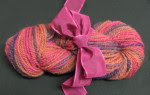
At the Shenandoah Valley Fiber Festival this fall, among other treasures, I picked up this little ball of hand-dyed Romney roving from Catoctin Creek Farm, near Frederick, Maryland. (I have to think kindly of people who care enough about a humble ball of roving to tie it up with a satin ribbon.) I hadn't spun wool from Romney sheep before, and the colors seemed bright and kid-friendly. I thought it would be fun and might make a cute scarf.

Spinning the Romney wool was a real pleasure. It's a long-wool breed, with long, luscious fibers that drafted out so smoothly that they made me feel like a more skillful spinner than I really am. It felt cottony and flossy. The preparation was immaculate, a very welcome change from some of the fiber I'd been working with over the summer.

For spinners, who may care about such things, I split the rope of hand-dyed roving lengthwise and spun the two halves onto separate bobbins. The plan was for the color changes to occur in more or less the same place so that the colors would stay mostly pure when the strands from the two bobbins were plied together.

When I began plying, though, I found that either my splitting or my spinning was uneven enough that the results were unpredictable. The colors blended and softened and became surprisingly complex. It was prettier and paler than I'd imagined. The colors began to remind me of my grandma, who's always looked pretty in pastels. I started thinking that just maybe I could make something for her.

This was no small matter. I'd only knitted from my hand-spun twice before. Of my earlier efforts, another relative had said, "hmmm, it's kind of scratchy." That hadn't exactly encouraged me to think of it as gift-worthy. (And I have to admit that, while I do love the two hand-spun sweaters I've made thus far, I wouldn't be anxious to wear them against bare skin.)

I was reading something at the time that gave me a notion that fulling the yarn might make it a bit softer and woollier, so I decided to give that a try. When all the yarn was spun, after consulting my spinning books, I took my latest fiber processing tool in hand. (Yes, a plunger.) Ignoring the yarn's cries of protest, I shocked it cruelly in hot water and cold, and commenced to beating it senseless.

I didn't like doing it, but it was for its own good. I also learned a couple of lessons myself. One is that enthusiastically agitating yarn in a large sink of water is a very splashy operation. Less water next time. Or a raincoat.

Despite a certain skepticism I still harbored about the wisdom of all this, the yarn survived and even bloomed. The strands lightened and loosened, but bound together more as a whole, and developed a fuzzy halo. I think this may have been an experiment worth repeating.

I worked out a design for a scarf and got to knitting, thinking of my grandma all the while.

It was entrancing, watching the colors shift and merge as the scarf grew from the needles. And nothing really repeated. The color patterns were unique the whole way through. It was a lovely experience, from one end to the other.

I'm still worried about whether it's soft enough. For myself, I wouldn't mind a slight cold-weather scratchiness at all. But this is for my grandma. I think I spun it as softly as Romney can be spun, with low twist and plenty of air. But it is simply a coarser wool than the aristocrats of the woolly world, like merino. So I wish I could give it that buttery feeling, but it has its own nature. If it's not perfectly comfortable against her skin, maybe she can wear it outside a coat collar. Or not wear it at all, and just show it to her friends, and say "my granddaughter made this."

So I wrapped it up tenderly and shipped it off for Christmas, hoping that it will be nice enough. At least she will know that I wanted to make her something that I spun myself.

I hope she likes it.

Sunday, September 21, 2008

Ready for the Weather

I now declare myself ready for the colder weather that's just around the corner. Why? Because my hand-spun Stormwatch sweater is here! It's a big woolly bear of a sweater. A cozy rag rug of a sweater. When I spun this yarn, I pictured a big slouchy cardigan, and by gum, that's what I got!

I was seriously worried about whether there was enough yarn to finish the Stormwatch sweater. I'd bought some inexpensive roving at a festival, described rather generically as "medium wool," that turned out to be, well, not a lovely high-quality fiber to work with. It was lumpy and full of neps, and maybe the less said about that the better. I labored mightily to turn this homely stuff into some sort of usable yarn, blending three colors together, and making a virtue of necessity by tolerating the lumps and aiming for a coarse, rustic yarn. So when this was gone, it would be gone.

About halfway through the Stormwatch sweater, I was really starting to fret. But then thank goodness for Bess, the sweet voice of reason, who suggested in the comments that if I ran short I might be able to do something nice with stripes in the sleeves, to make up any shortage with another harmonious yarn.

As it turned out, I had enough yarn and a bit more. (I'm glad I didn't design the sweater to be a single inch longer, though.) But I can't tell you how freeing it was to realize that if I didn't have enough, I could just call it a design feature and still wind up with a sweater. After that, I clicked light-heartedly away. Thanks, Bess!

Whenever I design my own sweater, though, I have worries to spare. Stormwatch is a saddle-shouldered design, which I haven't tried before. I wanted a scoop neck, but I wasn't sure how big to make it. I measured and eye-balled against some of the other sweaters in my closet, but didn't have a good feel for how the saddle shoulder design would affect it. It's a big wide-open neck, that's for sure. I thought I'd blown it. But when I got the buttons on today, it started looking a lot better. When I realized I could layer any kind of collar under it, even a big cowlneck, it looked a little better even yet. When my mom-in-law, who happened to be here for a visit, singled out the big open neckline for compliments, it started looking so much better I could almost convince myself if was intentional. :)

The Stormwatch yarn did indeed turn out to be bulky. (Portly, I think may be the word I was looking for.) The sweater is knit on US size 11 needles, at a gauge of 11 stitches/4 inches. Because of its bulk, when I seamed it up, I tried out a tip I'd seen but hadn't done before, which is to use a different, lighter-weight yarn to sew the seams.

I happened to have a partial ball of Dale Baby Ull lying around from a past baby bootie project, in a medium gray that blended perfectly with the complex blue-gray of Stormwatch. (A good omen for the project, maybe? And all the buttons being on sale when I went to the local fabric store in search of something suitable. Clearly the planets were aligning for this sweater.) It's a fingering weight 100% superwash wool yarn, and it was very lovely to work with in the booties project, I might add.

So the Baby Ull is what I used. It worked out swimmingly. I just might have to use that trick again, when working on a bulky project. It added practically no bulk at the seams. It was an interesting contrast, as well, between the nubby, grabby handspun and the smooth commercial superwash yarn. I can now understand why people refer to superwash wool as slippery. It certainly slipped through easily when I pulled up a thread to tighten a seam, that's for sure. Because of that, I was very careful to anchor the ends securely, weaving in a longer length and changing directions a few times.

All in all, I'm very pleased. I made a mistake buying a penny-wise pound-foolish bargain, but persevered and made something I'm happy with instead of giving it up for lost. I'm stubborn that way, I'm afraid. But I may have learned my lesson. I'm not that stubborn. I'll evaluate more carefully instead of just getting carried away by a sale. And, spinning novice that I still am, I learned a lot about what makes a fiber good to work with and what kinds of effects you get when it's not ideal. So all that was lost is some aggravation, and some imaginary smooth svelte sweater that it might have been if it were other wool.

And it's ended well, I must say. This is the kind of sweater that is so comfortable that, once I had it seamed up and tried it on, I was reluctant to take it off even to sew on the buttons. Something tells me I'll be living in this one, pulling it on by default whenever it's chilly and I need a little comfort. I didn't really know where I was going with my bargain roving, but I'm glad I wound up here. Welcome, Stormwatch!

Wednesday, September 10, 2008

Hurly-Burly

Things have been awfully busy lately. Work has been pressing, and even my weekends have been spent thinking about it. This is something I do not normally encourage. If it weren't for a couple of chances to wear my new Crossed Laces tank with a natty blazer and collect a few compliments, I don't know what I'd have done for fun.

So life has been hurly- burly. One is only human, though, after all. Somehow I managed to get a chance to do some swatching with my hand-spun Stormwatch yarn.

It too might be called burly. Not hurly, though. That would just be unkind.

Burly, in fact, is quite a nice old-fashioned word. I seem to remember that, once, men who might now be referred to prosaically as overweight would instead have been called burly. (I don't think it was ever applied to women; it has such a doughty masculine air.) Stout or husky might have been in the rotation as well.

But the Stormwatch yarn, more precisely, has turned out to be bulky. By eye, I had thought perhaps worsted-weight, but my eye clearly needs more training. This yarn knits into a nice pliable fabric on US size 11 needles but cardboard on US size 9s. At a bulky gauge, it's husky, bumpy, and pleasantly not-quite-scratchy. And, by the way, I've figured out how to control the light balance on my camera, so the color in the picture is pretty close to reality.

As the weather freshens, the heavy hot air of summer has lifted, the days are shortening, and the nights are cooling, this yarn seems quite the thing. The sap is beginning to run through me, demanding that I knit hearty cold-weather sweaters. I don't know if sap runs in the fall, but if it rises in the spring, then surely it must have to migrate somewhere else for the winter.

So I've sketched out plans for a big enveloping rustic cardigan, with saddle shoulders and a wee bit of texture. I don't want a stitch pattern that would bury that hand-spun nubbiness or be swallowed up in return. But on the other hand, pure stockinette, with its insinuation of sleek, even smoothness, doesn't seem quite right either. I experimented with a number of ideas, eventually growing a very large swatch, until I had something I thought might work.

I'm motoring up the back of the sweater now, with about 5 inches of length to go. The knitting is fun and going quickly, but the worries are starting to jostle in the back of my mind. I'm not too picky about fit on this one, but I don't know if I will have enough yarn. If I run out, there will be no more. Not only is this hand-spun, but it was a rescue exercise, making a usable yarn "with character," from some near-disastrous roving. So I will work with what I have, and alter the project, if necessary, to suit.

It seems like I'm burning through the skeins of hand-spun at an awfully lively clip. I'm pretty sure I'm on skein number five (of 17) already, even before finishing the back. But being hand-spun, they're all different sizes, and I think I'm subconsciously grabbing the smaller ones first.

So here's my plan. I've estimated that, in square inches of fabric, the back of the swebater is about 2/7 of the whole thing, front, back, and sleeves. (And of course, to keep it simple, I'm ignoring niceties such as the yarn need for button- and neck-bands.) When I get the back finished and cast off, I will weigh it. Then I'll calculate ratios to see if it looks like the rest can be done with the yarn remaining.

I don't know. It may be touch and go. I spun a pound and a half of this yarn. My Cannonball sweater weighs only about a pound, but it's not bulky. My Comfy Winter Turtleneck came in at a whopping two pounds, but it's bulky Cashmerino, which weighs a ton.

If it looks like I'm not going to make it, I will have to drop back and regroup. With a change of armhole, it could become a vest rather than a sweater, I suppose. But my mental image is firmly fixed, and it's not the mental image of a vest.

So I'll just plunge on ahead and worry. Well. For every sweater a gray hair.

Wednesday, April 30, 2008

Now, What Was So Scary About That?

I did it! I did it! I took the plunge and knitted some of my own handspun.

I had run out of delaying tactics. The Merino Lace socks were finished, and all the additional wool in the new gray color was spun. I told myself that I was not allowed to start any other knitting or spinning projects until I got started on the handspun sweater I've been sneaking up on all this time. That gave me just the little push I needed to get over the hump. I felt stymied, briefly, bottled up and frustrated. But in a couple of days I gathered my mental energy, got up a head of steam, and got going.

First I needed to get better acquainted with the yarn, which up until then I had only petted and admired. I tried doing the wraps-per-inch test, but I'm not sure I had that right, as it kept coming out as chunky weight, which it assuredly isn't. Next I painstakingly counted all the threads in the skeins to estimate yardage and wound them into balls. It felt alive and resilient in the handling. I carefully weighed each ball and calculated the yards per pound. That didn't really tell me much either. How many yards per pound should there be for a given thickness of yarn? I'm not experienced enough to say. The one thing this exercise did tell me is that, although it looks fairly consistent, the yarn varies quite a bit in thickness from ball to ball.

Finally, there was nothing for it but to actually knit some of the stuff. I took a wild guess and grabbed a pair of US size 7 needles, jumped in and started swatching. It worked up in the neighborhood of a worsted-weight gauge, a little loftier than I realized.

And you know what? It's real yarn. Yarn that you can knit with. Rather nice yarn, in fact. It's crisp and eager to please. It doesn't drape lazily like the Cashmerino; it perches on the edge of its seat, ready to jump up and go, light on its feet. Right then, I told it, let's get to work! I still had some work left to do to sort out the details of the sweater design, but set to it with a will and soon had it done.

I needed something that would use the five different natural colors of Coopworth wool that I had spun. I didn't actually set out, originally, to make a multi-colored project; it just happened. It all started with a half-pound of dark brown Coopworth that I bought to practice on when I first got my spinning wheel. Then, wondering what to do with the yarn, I found other colors to combine with it. Of course, I don't think I'll end up actually using that first bit for the sweater. It's the yarn I learned on, and it shows, though I love it all the same.

I settled on a color-blocked design, with set-in sleeves and a square neck, and swatched to see how the colors would look. The warm tan really seemed to jump out from the other colors. So instead of graduating all the colors from dark to light, I moved the to the bottom as a sort of edge accent. I tried out the cable motif I want to use down the front, to make sure it would work. And since it needed a name, I dubbed it the Cannonball sweater.

So now I'm happily on my way. In fact, I took it with me on yet another trip this week. Normally, I take socks for portability, instead of a bigger project, but I think I've had enough of socks for now. So I packed circular needles for the plane and straight ones for the hotel room and, optimistically, five balls of yarn, one in each color.

I did get quite a bit done by the time I got back, thankful to be home again. Here's most of the back, and I'm partway up the front as well. Of course, stockinette stitch in worsted weight does go quickly -- a welcome change after a stint of lacy patterns in tiny sock yarn. In any event, I'm awfully excited to have this project underway and see how it will turn out. And I'll never again be quite so hesitant to dive in and knit with my handspun.

Thank goodness, the Cannonball sweater is finally rolling!